
What is a CV joint or constant velocity joint?
There are several types but a constant velocity joint or CV joint consists of ball bearings or rollers with needle bearings that allow for near constant velocity throughout the parts allowed range of motion.
Who needs CV joints?
You would be surprised. If you drive something made in the last 20 years odds are there are CV joints that drive your vehicle. But that is only the most common use of CV joints. There may be some in the steering that actually turn the steering column in your vehicle. Additionally there are CV joints in equipment and manufacturing. There are many factories that use CV joints running their manufacturing equipment. This brings another question WHY? If you think about your car when you are driving the CV joints deliver the engines power to the road smoothly whether you are driving straight or turning. Also the modern AWD car and 4X4 truck uses these in the front axle to smoothly put power to the road. CV joints do the same thing as universal joints but deliver power in a more even and efficient way. In doing so CV joints eliminate the inherent flaw in universal joints of changing acceleration. This is the CV joints best feature. Since a universal or u-joint accelerates and decelerates twice per revolution with the speed change increasing with angle the universal joint is limited to use in application where uniform and even power delivery is not critical. The constant velocity of a CV joint is what makes for efficient automobile drivetrains. Taking this to a larger scale CV joints in the industrial realm make for more efficient shafting in stationary equipment. In mechanical drives CV shafting connects drive and driven ends, performing multitudes of tasks with improved performance over universal joint shafting in many instances.
There are CV joints for high speed use as well. These are used in engine dynamometers and as driveshafts in rolling stock applications.
Limitations: CV jointed shafts are not perfect, there are limitations:
The CV shaft is a behind the scene piece of manufacturing and mobility, but it is used in manufacturing many things you use everyday....from rolling the toilet paper you buy to making the box in which your last package was delivered...from moving a hybrid electric car to moving a military vehicle...from testing the engine on some Sunday racing stock car to testing the engine on a open wheeled racer...from grinding ore for the aluminum industry to pumping gas in the oil industry...from tube mills to paper mills....from labeling machines to canning machines... from one inch 25mm CV joints to ten inch 254mm or larger.
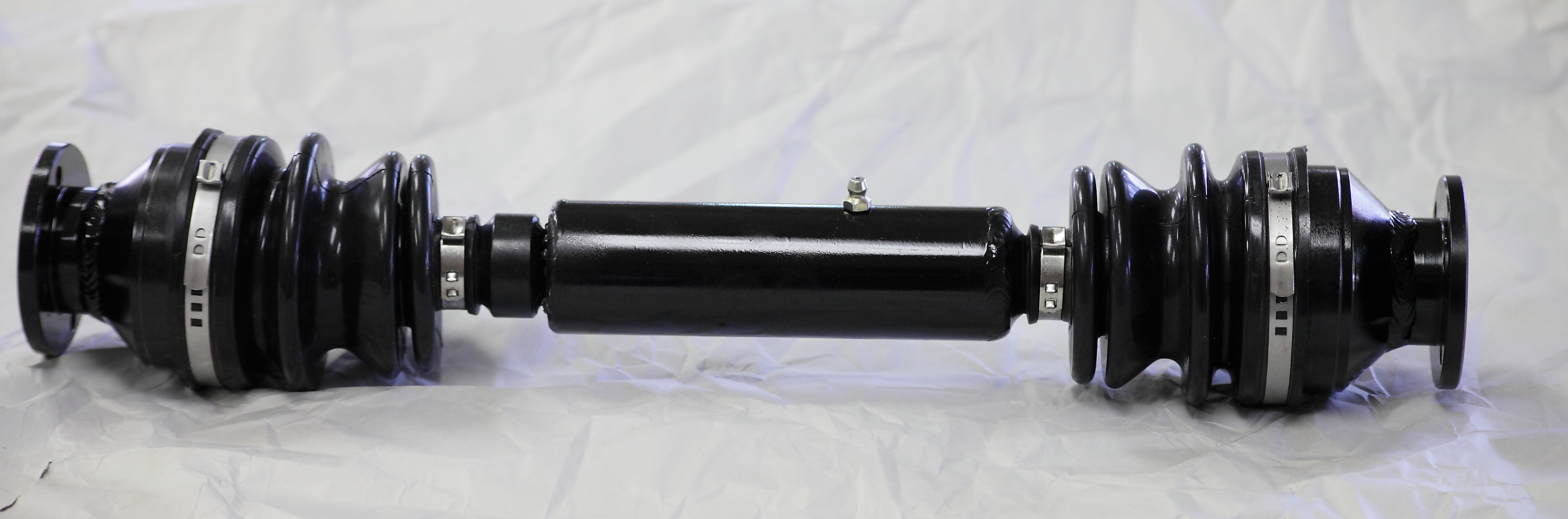
CV shaft with center slip spline for paper product production. This shaft is a replacement for the original.
Cardan/u-joint vs CV joint
Axial Forces
Axial forces are induced in cardan
shafts.
These forces must be absorbed by axial thrust bearings.
Axial forces will occur during the
length variations in the cardan shaft.
These forces increase in magnitude as torque is
increased.
The forces increase in duration as angle is increased.
Additional axial forces are incurred during
lubrication of the splines though this decreases automatically.
The axial force is a combination of two components:
Frictional Force
Frl=torque*(friction
coefficient/pitch circle radius of slip assembly)*(1/cos of the operating
deflection angle)
2 Lube Force
Force occurring in the length from increase pressure in the
splines of the slip assembly Max 215PSI
Radial Forces in Cardan (U-Joint) shafts:
Torque transmission from angle
deflected cardan shafts cause additional forces in the bearings of the connected
units.
These forces are NOT constant and vary periodically twice
per revolution.
These forces increase with angle and configuration.
As the angle becomes larger the
bearings of the connected units must be larger to support the increased forces
induced by the Cardan/u-jointed shaft.
Laws of physics apply regardless of the type of
shaft Cardan/u-joint or CV.
CV shafts do not impart additional axial forces
(acceleration/deceleration) into the system hence the name CV or constant
velocity.
The formulae for these forces is documented in the application
guides from Spicer and GKN.
CV jointed shafts have a constant delivery of torque with a friction coefficient that remains constant while this does increase with angle and torque it doesn't induce a varying force in the system.
While CV jointed shafts are not best
for all applications use of CV shafts in general are more efficient in torque
delivery, and will improve bearing life on the drive and driven ends.
For industrial applications this will result in
reduced maintenance costs, lower power requirement, less induced harmonics (less
vibration and noise), more uniform product.